
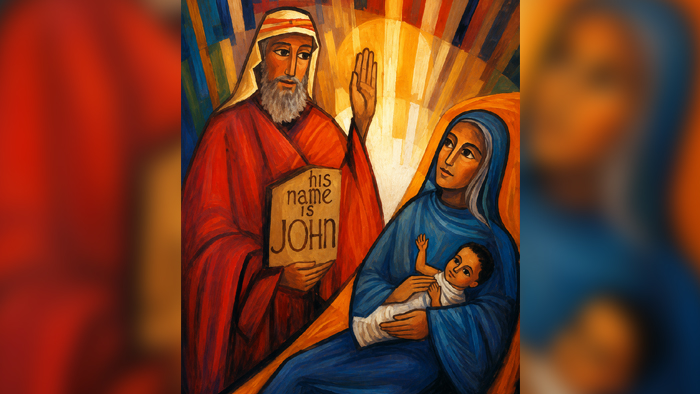
Who are you? This is what the readings of the 13th Sunday in Ordinary time ask us. Normally the first thing that comes to mind is the name we received at Baptism and our Family name. “I am so and so!” Jon Kirby or Elmer Fudd. But when thinking a little deeper, other things start appearing. For example, ancestors. I was named for my grandfather who was named for his father. Going still deeper, we arrive at the spiritual dimension. On the 24th of June we celebrated the Birth of John the Baptist. We recall how by normal Jewish practice Zacharia’s son should have been named after him, but the Angel of the Lord appeared and told him it will be John. Even from his birth Jesus was breaking convention.
In Northern Ghana fathers go to diviners to find a name for their child. The diviners will search the unseen world for the virtuous ancestor who will con-fer on the child its true identity. As the child grows and matures those who personally knew this ancestor will tell the child how its namesake used to act and the child will act as instruct-ed. Slowly, over time the child’s identity will be molded on that of the virtuous ancestor. So who we are Involves many things: family, ancestors, friends and relationships, country, personality, culture, jobs and everything that makes us who we are. Each element or dimension enlarges our identity enabling us more and more to become who we are.
In my life, it was only after I entered the seminary that I started to reflect on who I am and how I build up and enlarge my identity. For the first time I became aware of name-days and patron saints. Realizing that this is very important for one’s identity and direction in life, I found myself in a quandary. There are two Johns. So which is my patron—the Evangelist or Baptist?
There was nothing that attracted me to John the Baptist. He was rough, unpolished, wore animal skins, lived in the desert as an outsider, ate locusts and as a prophet was considered a bit mad. John the Evangelist, on the other hand, was quite appealing. He was full of youthful enthusiasm, the closest disciple to Jesus even to the point of laying his head on his shoulder. He had a special connection to Jesus, and I felt a special connection to him. Among all my brothers, as the first-born child I was my Dad’s fair-haired boy.
Then in 1975, after three years in Ghana, I went on my first home leave, it was on June 24th the feast of the Birth of St John the Baptist that my Dad said to me: “How are you going to celebrate your names day?” I was taken aback at this and cheekily corrected him, “I’m St. John the Evangelist, not the Baptist!”
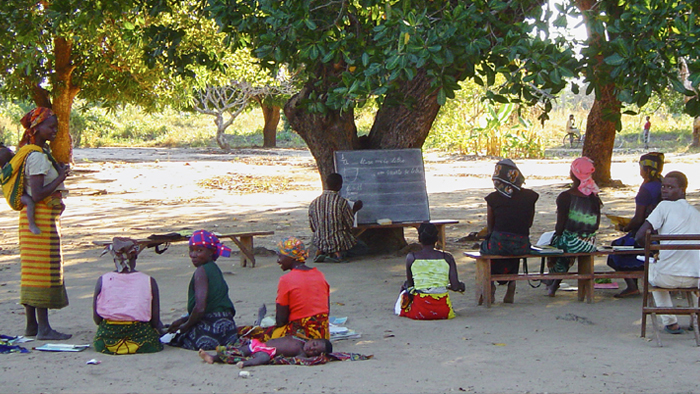
I went back to Ghana and for a long time continued to see myself as the Evangelist—a scholar, a writer and teacher. I translated many texts into the local lan-guages and even helped the Ghana Institute of Linguis-tics translate the New Testament into the Anufo lan-guage. But I began to sense an internal conflict. Here I am in the Ghanaian jungles and deserts, eating strange foods and living a rough life as an outsider. Something urged me to go deeper and investigate. I was doing primary evangelization among traditional be-lievers and Muslims but making no conversions. Just introducing the people to Jesus and his message using their own language and cultural proclivities and I started to see the broader connections to my identity.
John the Baptist said: “He is the one coming after me.” I thought, a culturally Ghanaian Jesus will be coming after me. The Baptist said: “You, child, will be called prophet of the Most High for you will go before the Lord to prepare his way.” He said: “He will go before him in the spirit and the power of Elijah . . . to prepare a people fit for the Lord.” I had been preparing the way for Ghanaians to find the Lord in their own lives, cultures and traditions.
As soon as my eyes became open, more connections kept turning up. For example, I suddenly realized that the day of my baptism, which was two weeks after my birth, was June 24th, the feast of St John the Baptist. I chose the Evangelist, but the Baptist chose me. John the Baptist was with me all along in all that I was doing. In a sense I have been living into being who I am through the unrecognized presence of the Baptist. They say there are no coincidences in life. All things have a purpose. All are part of God’s plan.
So back to the original question—who am I? I now recognize myself in both Johns. Both have helped me to see myself as belonging to a much bigger Family that includes the SVD, the people of Ghana and all of humani-ty—the people of God, the true family. Our true identity, our God family, starts with baptism. By acting like his family, more and more we become his family and are brought ever deeper, more and more to New life.
Fr. Jon P Kirby, SVD